Vintage Childhood Clipart Set Review
As a designer who spends more time than I care to admit staring at stitch charts and fabric swatches, I am constantly hunting for designs that balance nostalgia with technical viability. We have all seen clipart sets that look charming on a screen but turn into muddy, unrecognizable blobs once they hit the hoop. That is why when I first pulled up the Vintage Childhood Clipart Set, I didn’t just look at the aesthetic; I looked at how it would behave under the needle.
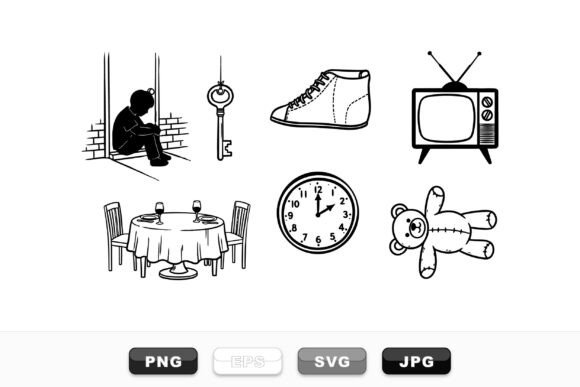
This collection of monochrome vector icons—featuring a sad boy sitting in a corner, a vintage key, a high top sneaker, a retro television, a table setting, a clock, and a teddy bear in minimal style—is not just a pile of cute images. It is a curated library of emotional anchors. For embroidery designers, small business owners, and crafters, the question is never just "does it look good?" but "will this sell?" and "can I actually stitch this without pulling my hair out?"
The Mood: Nostalgia Meets Minimalism
The immediate impression of this design set is one of quiet storytelling. The inclusion of a sad boy sitting in a corner alongside a vintage key and a teddy bear creates a specific narrative arc. It feels like a memory you can hold in your hands. This is powerful branding material. In a market saturated with bright, loud, and overly complex graphics, minimalism stands out because it allows the texture of the thread to do the heavy lifting.
Because these are monochrome vector icons, they offer incredible versatility. You are not locked into a specific color palette by the artwork itself. Instead, the mood is dictated entirely by your thread colors and the fabric texture you choose. A black teddy bear on white cotton evokes a stark, modern nursery vibe. The same bear in muted gold on charcoal gray linen shifts the tone toward sophisticated boutique decor. This flexibility is exactly what Etsy sellers and craft business owners need to create cohesive collections without reinventing the wheel every time.
Real-World Application: From Screen to Stitch
Let’s talk about where this embroidery project truly shines. I recently conceptualized a custom embroidered tote bag line targeting young parents and gift-givers. The goal was to move away from generic "baby" motifs and toward something more sentimental and timeless. The Vintage Childhood Clipart Set fit this brief perfectly.
Imagine a sturdy canvas tote featuring the table setting icon stitched in cream thread. It suggests family, meals, and gathering. Or consider a sweatshirt embroidery design using the high top sneaker and retro television. These items resonate with millennial and Gen Z audiences who value authenticity and retro aesthetics. When you translate these vector shapes into a machine embroidery design, the clean lines ensure that the final product looks intentional and professional, rather than haphazard.
For those creating personalized gifts, the vintage key and clock offer subtle symbolism. A key can represent unlocking memories or new beginnings, while a clock speaks to cherishing time. These are excellent hooks for marketing. When a customer sees an embroidered patch with these elements, they aren't just buying a decoration; they are buying into a story. This emotional connection drives higher conversion rates and encourages customers to share their purchases on social media, providing free organic marketing for your shop.
Technical Considerations and Stitch Clarity
While the visual appeal is strong, any experienced designer knows that beauty must be backed by structural integrity. The Vintage Childhood Clipart Set relies on minimal style, which generally works well for embroidery because there is less clutter to confuse the eye. However, simplicity can also expose flaws if the digitization isn't handled correctly.
When evaluating this set for real use, pay close attention to the stitch density. Minimalist designs often use large areas of solid fill or long satin stitches. If the density is too high on a lightweight fabric, you will see puckering. If it is too low, the underlying fabric might show through, ruining the crispness of the sad boy silhouette or the details of the retro television. Always test the design on scrap fabric first. Check how the stabilizer interacts with your chosen material. For stretchy fabrics like jersey used in baby embroidery, a cut-away stabilizer is usually non-negotiable to maintain shape over time.
The hoop size is another critical factor. While these icons are scalable, extremely small hooping can cause issues with registration and thread tension. If you are planning to produce tiny accessories, such as aprons or kitchen towels with small accent patches, ensure the design scales down cleanly without losing its identity. The teddy bear should still look like a bear, not a smudge, when reduced in size. Conversely, larger formats, like pillow covers or nursery decor, allow the viewer to appreciate the fine details of the table setting and the expression of the sad boy.
Where to Use Caution
Not every surface is created equal. There are specific scenarios where this design set requires careful handling:
- Dark Fabric: Because the source vectors are monochrome, you must plan your thread colors meticulously. On dark backgrounds, light threads may require a backing layer or underlay to pop, which adds thickness. Test contrast levels before committing to a bulk run.
- Textured Fabrics: Rough weaves or heavily textured materials can obscure the clean lines of the minimalist style. Smooth cottons, linens, and blends tend to yield the best results for this type of graphic.
- Curved Surfaces: Applying this to caps or hats requires precise digitizing to account for curvature. Flat designs often distort when wrapped around a curved form, so ensure your digital embroidery file is optimized for 3D forms if you intend to go this route.
- Detailed Corners: The vintage key and clock have intricate parts. Ensure that the smallest details are large enough to be stitched clearly. If a detail is smaller than a few millimeters, it may get lost in the stitching process.
Strategic Value for Sellers and Makers
For design assets creators and commercial embroidery professionals, the Vintage Childhood Clipart Set offers significant value beyond a single product. Its versatility allows you to create a wide range of handmade products that feel connected yet distinct. You can use the high top sneaker for streetwear-inspired custom apparel, while using the teddy bear for soft goods. This cross-pollination of themes helps build a recognizable brand identity.
Furthermore, the monochrome nature of the vectors makes them ideal for creating printable mockups and digital product previews. Before you even stitch a single sample, you can present these designs to clients or customers in various colorways and contexts. This is particularly useful for small shop products where inventory risk needs to be minimized. By validating interest through digital previews, you can gauge demand before investing in physical production.
Finally, always confirm licensing terms. Whether you are selling finished items or offering digital embroidery files, understanding the commercial rights is crucial. The Vintage Childhood Clipart Set provides the visual foundation, but your success depends on how responsibly and creatively you apply it. Treat each stitch as an investment in your reputation. By choosing designs that are emotionally resonant and technically sound, you elevate your work from simple crafts to meaningful art.
In conclusion, this set is a strong candidate for any designer looking to tap into the nostalgia market without sacrificing modern aesthetics. It is practical, adaptable, and deeply human. Just remember to respect the mechanics of embroidery, test thoroughly, and let the quality of your execution speak for itself.